Text Size


Search Articles
More By This Author
- Remembering the Soul.
- What makes Shiners Shine?
- The precious wholeness of things.
- So what do you see?
- The Big Black Bulging Bump.
- ...all 45 articles
More From This Category
- Find the missing pieces!
- Every Person.
- Freedom, Faith and Community.
- The best of friends.
- Expect the unexpected.
- ...all 298 articles
Article Information
- Added July 18th, 2010
- Filed under 'All Sorts'
- One attached file (jpg, 11kb).
- Viewed 4373 times
Beatrix Potter and Peter Rabbit.
By Colin Gibson in All Sorts
While loving Peter Rabbit we also need a grown-up perspective of the big bad world.
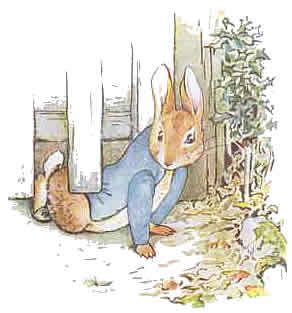
On the fourth of September 1893 she sent an illustrated letter to Noel Moore, the five-year-old son of her friend and former governess, Annie Moore. Noel was recovering from a bout of scarlet fever, so Beatrix amused him with a story based on her own pet rabbit, Peter Piper: 'I don't know what to write to you, so I shall tell you a story about four little rabbits, whose names were - Flopsy, Mopsy, Cottontail, and Peter...'.
In the following years Beatrix sent other picture letters to Noel and his brother and sisters, including stories about an 'excessively impertinent' squirrel called Nutkin and a disconsolate frog named Mr Jeremy Fisher. In 1900 Annie suggested to Beatrix that her picture letters might contain material for several picture books. Fortunately, the children had kept their letters safe and Beatrix was able to borrow them to copy and rework her text and illustrations. Noel's story of Peter Rabbit was to become Beatrix's first book in a famous series.
She wanted her picture books to be small (to fit a child's hands) and affordable, with a black and white illustration on every page to hold the attention of even the youngest reader. But at least six publishers turned down her manuscript; they wanted a larger, more expensive book with colour illustrations. So she decided to publish The Tale of Peter Rabbit herself.
One copy of Beatrix's privately printed edition contains the following inscription:
'In affectionate remembrance of poor old Peter Rabbit, who died on the 26th of January 1901 at the end of his 9th year. Whatever the limitations of his intellect or outward shortcomings of his fur and his ears and toes, his disposition was uniformly amiable and his temper unfailingly sweet. An affectionate companion and a quiet friend.'
Later, a family acquaintance encouraged the publishers Frederick Warne to reconsider Beatrix's books. They did so, and the rest is history. To her own astonishment, Beatrix Potter's little books became best sellers. Now one of the most popular children's books of all time, The Tale of Peter Rabbit has gone on to sell 40 million copies world wide.
I have always loved those little books, and especially the tale of that naughty rabbit. But as an adult I have gone on to read many other books with different visions of the world-Watership Down among them, in which rabbits fight ferociously with each, become refugees and have to combat a terrible plague. And I wonder if too many Christians are content with their Sunday School version of Jesus as one whose 'disposition was uniformly amiable and his temper unfailingly sweet. An affectionate companion and a quiet friend.' I understand their deep and abiding affection for Jesus as a cuddly rabbit, but I hope they will grow to realize that there is more to be said and learned about one who gathered small children to himself but also faced up to the big bad cruel real world, and changed it forever.
-- Colin Gibson
First printed as a Connections article in the Parish weekly bulletin, 18 July, 2010.

