Text Size


Search Articles
More By This Author
- Doing worship in the future Prolonging ‘as is’, or pressing on to pave other ways?
- Faith and Feeling.
- Youth ‘n age ia
- THE REFORMATION Half a millennium since it started – still needing twi
- Deptheism
- ...all 33 articles
More From This Category
- GOOD HUMOUR / GOD HUMOUR.
- A VISION FOR THE DUNEDIN METHODIST PARISH IN THE 21ST CENTURY
- Doing worship in the future Prolonging ‘as is’, or pressing on to pave other ways?
- Reflections on the future of the Methodist Church in Dunedin and some comments on mental health.
- Methodism with a future, if all cells begin to devise a plan to create something New!
- ...all 95 articles
Article Information
- Added February 12th, 2011
- Filed under 'Articles'
- One attached file (jpg, 3kb).
- Viewed 2658 times
Wholly Holy?
By David Kitchingman in Articles
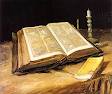
David considers the history of the Bible in English.
Hi Jo
I know how busy you are, but if you could find half an hour or so to take a peep at the Dunedin Public Library's exhibition before it closes on 20 February you might be surprised at how gripping a story it tells. 'Let there be light: Celebrating the Bible in English' does much more than just honouring the wishes of one of our Parish's most distinguished former members, A. H. Reed.
In case you can't make it, here are some disturbing aspects of the exhibition.
The Wycliffe Bible (1382) was the first major translation of the complete Bible into English. It was seen as heretical by Church authorities who deemed it an offence for the Verbum Dei to be translated into a vulgar tongue. In 1409 a provincial synod at Oxford banned John Wycliffe's work and forbade anyone to translate any part of the Bible without permission from a bishop. Bishop Arundel spoke of 'that wicked and pestilent fellow ... doing the work of Anti-Christ by the expedient of a new translation of Scripture into the mother tongue'.
The Council of Constance demanded that Wycliffe's writings be burned and ordered his bones exhumed from consecrated ground. In 1428, his bones were burned and the ashes scattered into the River Swift. Wycliffe's greatest successor in the task of English translation, William Tyndale, met an even worse fate, being executed by strangulation in 1536.
Damned if you did.
Yet not all that much later, in 1579, the Scottish Parliament passed an act stating that 'every householder worth 300 merks [a Scottish silver coin] of yearly rent, and every yeoman or burgess worth £500 stock [was] to have a Bible and Psalm Book in the vulgar tongue ... under the penalty of ten pounds'.
Damned if you didn't.
Why is it that the Bible has led to so much controversy and cruelty across the ages? My answer may not be welcome in most church circles. It is the inordinate obeisance accorded it over time, as reflected in its customary title, the Holy Bible. 'Holy' is a dangerous word when out of control. 'Holy Bible' was not a title claimed or capable of being claimed by the collection itself, the multifarious writings of which spanned more than half a millennium.
Indeed, if it could have provided its own title it would have been very wary of choosing 'Holy Bible'. The word 'bibliolatry' acts as a warning against one of the very themes which does permeate the Bible - the deep distrust of idolatry of any sort. That warning would also apply to sacred scriptures themselves, even those bequeathed by Judaism and early Christianity.
It might help to think of the Bible as a long and mighty river with various tributaries. Chiefly it is a source of life, beauty and refreshment. But occasionally it has dangerous rapids or stagnant reaches. As it moves along it not only carries a pure melt from the heavens; it is also subject in places to poisonous runoff from along its banks.
It is not wholly holy. Sometimes its texts are terrible. John Shelby Spong wrote a provocative book confronting the contradiction. In 2005 he published 'The Sins of Scripture: Exposing the Bible's Texts of Hate to Reveal the God of Love'. He tackled texts that have been used throughout history to justify the denigration or persecution of others, including slavery, anti-Semitism, sexism, homophobia, and child abuse. His positive construction was to argue for reading scripture as epic history so as to uncover a loving God beneath the patriarchal and tribal attitudes.
So perhaps a better title than 'Holy Bible' would be one that has become quite popular nowadays. 'Gracebook' may be a trendy title but it captures the essence of the Bible's supreme virtue, and even its power to redeem itself. And that is still very much alive. A recent D-scene issue (26 January), tells how a notable deer hunter, Alex Gale, became a Christian after reading the Bible over a six-month period in the bush, going on to lead Baptist churches, currently in North East Valley. A case of the Bible at its best.
But, sadly, some churches approach the worst strains in the biblical saga as welcome reinforcement of their prejudices. The standard response of many others, even some liberal ones, is to soft-pedal the nastier stuff (aided in part by a selective lectionary) and to hope that the inspirational parts will more than compensate. If such glossing over of the negatives while accentuating the positives was ever a passable strategy it is no longer tenable.
This year will mark the 400th anniversary of the first printing of the King James Bible in 1611. It is a cause for celebration for both the Church and English language culture. But it is a very different world that now looks upon the Biblical world. The Church may find it convenient to retain the traditional trappings surrounding its use of the Bible. It may be comforting to say, 'These are the lively oracles of God'. But it can also inadvertently help to reinforce reliance on scriptural interpretations that are a cover for deep-seated prejudices.
It is time to revisit the manner in which the Church has privileged the Bible. For example, it is still common enough for a reading to be followed by the words, 'May God add His [sic] blessing to the reading of His [sic] Word'. To continue to equate the Bible with the Word of God is to risk falling into the same trap as the medieval Church with its elevation of the Verbum Dei to untouchable status.
In the words of one of the contributors to the book of Genesis, echoed by William Tyndale and now by the Library's exhibition, 'Let there be light.'
-- By David Kitchingman.
First printed as a Connections article in the weekly Parish Bulletin, February 13, 2011.

