Text Size


Search Articles
More By This Author
- Doing worship in the future Prolonging ‘as is’, or pressing on to pave other ways?
- Faith and Feeling.
- Youth ‘n age ia
- THE REFORMATION Half a millennium since it started – still needing twi
- Deptheism
- ...all 33 articles
More From This Category
- Living Faith in a Dynamic Universe.
- Find the missing pieces!
- Every Person.
- Freedom, Faith and Community.
- The best of friends.
- ...all 299 articles
Article Information
- Added October 4th, 2010
- Filed under 'All Sorts'
- One attached file (jpg, 59kb).
- Viewed 2871 times
Labyrinthine Legacies
By David Kitchingman in All Sorts
Mazes and meanings for life
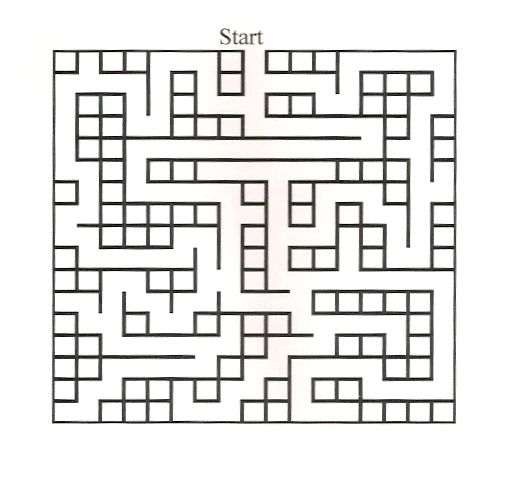
Some time ago at the funeral of a friend of ours mention was made of her dream of a permanent labyrinth for the community. That got me wondering what type of labyrinth or maze might most closely resemble a life's search for meaning and destiny.
The terms labyrinth and maze are often used interchangeably, but most often a labyrinth has only a single, non-branching path, which leads to the centre, whereas a maze may have a complex branching path with numerous choices and variable outcomes. Many mediaeval labyrinths symbolized God as life's destination, not altogether easily found, but sooner or later unmistakably reached at a clearly defined centre.
But now what? Both forms may attune with personal meditation but, for me, a maze is more authentic. See the maze above for how my own experience might shape up.
Puzzled? Then consider these quotations:
"We thought we were at the finish, but our way bent round and we found ourselves as it were at the beginning, and just as far from that which we were seeking at first".
--Socrates according to Plato's Euthydemus.
"We shall not cease from exploration
And the end of all our exploring
Will be to arrive where we started
And know the place for the first time".
--T.S. Eliot in Four Quartets.
"Religious thought today must go back to the beginning and confront afresh the basic parameters of human existence: the temporality, the contingency and the finitude of all be-ing; the constant uncertainty of life and the equally constant certainty of death".
--Don Cupitt in The Old Creed and the New.
"You must be born anew".
--Jesus according to John's Gospel, Ch 3, v. 7.
But trust Karen Armstrong to combine elements of both mazes and labyrinths, while adding a third dimension, in one of her autobiographical works. She speaks of her own life as a narrow spiral staircase. She had tried to get off it and join others on what seemed like a broad, noble flight of steps. But, in her closing words:
"I kept falling off, and when I went back to my own twisting stairwell I found a fulfillment that I had not expected. Now I have to mount my staircase alone. And as I go up, step by step, I am turning again, round and round, apparently covering little ground, but climbing upward, I hope, toward the light".
--Karen Armstrong in The Spiral Staircase: My Climb out of Darkness.
A labyrinth, a maze, a spiral staircase, perhaps a meandering garden pathway, or some other imagery of our life's journey? Which might be appropriate for us each to leave behind?
By David Kitchingman
First printed as a Connections article in the Parish Weekly Bulletin, Oct. 3, 2010.

